
Artificial Intelligence and Italian Manufacturing: Why 2026 Is a Decisive Year
THE'Artificial intelligence It has become the key driver for the future of Italian manufacturing. Artificial Intelligence and cognitive manufacturing will be the true competitive divide of 2026: will companies be ready to make the leap or will they remain anchored to an analog model?
Manufacturing remains the cornerstone of Made in Italy: it brings together wages, exports, applied research, and local supply chains. But with unstable energy, fragile supply chains, and new global competition, excellence alone is no longer enough. Without an organizational and digital leap, we risk a "Made in Italy" label reduced to a factory-less, job-less, and unintelligent label.
With initiatives like the manifesto for the new AI manufacturing reMade in Italy, the debate has shifted from simply investing in machinery to building intelligent production systems. In this context, Artificial Intelligence is not a technological gimmick, but the foundation of a new real-time industrial accounting system, capable of measuring and improving every single production process.
Artificial Intelligence and the Leap from Factory 3.0 to Cognitive Factory
Italy isn't starting from scratch: in recent decades, many companies have invested in mechanical automation, robotics, and advanced machinery. We are among the best in the world at building and operating systems. However, the last mile is often missing: the transition from the "automatic" factory to the truly "smart" factory, enabled by“Artificial intelligence.
In a cognitive factory, decisions about production, maintenance, logistics, quality control, and design are based on reliable data and tools capable of learning, predicting, and optimizing. It's the leap from individual performance to system robustness. Digitalization thus becomes the new industrial accounting: no longer a managerial fad, but the ability to know in real time what's really happening on the shop floor.
Measuring scrap and rework, setup times and micro-downtimes, energy consumption and process deviations means making the invisible visible. Whatever isn't measured can't be controlled, and what isn't controlled sooner or later generates costs, defects, and a loss of competitiveness. Artificial Intelligence allows us to transform this raw data into better operational decisions.
Artificial Intelligence as a Method: Maintenance, Quality, and Decision-Making Times
When taken seriously, the’Artificial intelligence It's not a veneer to be applied over production. It's a different way of organizing labor and capital. It allows you to move from "scheduled" maintenance to "condition-based" maintenance, preventing plant downtime and reducing waste thanks to the early identification of process deviations.
With Artificial Intelligence, it becomes possible to monitor quality throughout the entire process, not just at the end, when damage is already incorporated into the product. The time between signal and decision, between problem and solution, is compressed, transforming experience into a replicable method. This also simplifies the company's integration and digitalization journey.
Italy's true weakness is organization: technologies are often purchased that remain isolated, dirty and incomparable data accumulate, and pilot projects are launched that don't scale across the system. There's a lack of data governance, a prerequisite cybersecurity vision, and a management team that can bring different departments together. Digital transformation, on the other hand, is a discipline that requires integration, standards, data maintenance, and ongoing investment.
Why 2026 is the year of the cognitive factory
2026 represents a true crossroads for Italian manufacturing. In a context where competitors are industrializing innovation with digital platforms, learning production systems, and real-time reconfigurable supply chains, those who remain analog aren't standing still: they're retreating. And retreating in industry means entering a spiral of diminishing margins, less investment, fewer skills, and greater job insecurity.
In 2026 the’Artificial intelligence It becomes a standard part of competitive tools: no longer a perk for a select few innovators, but a prerequisite for staying in the most demanding supply chains. This is the year in which the shift from episodic adoption to systemic adoption is decided: reliable data, integrated processes, trained people, and clear governance. Those who get there first scale quality and productivity; those who lag behind are crushed by cost alone.
This shift also has a social dimension. Italy needs to raise wages, and this is only possible with greater productivity and the sharing of the benefits of innovation. Artificial Intelligence can free human labor from microtasks, bureaucracy, and managerial copy-and-paste, focusing people on high-value activities: quality, problem solving, exception management, safety, and customer and supplier relationships.
Cognitive factory, human capital and digital skills
Italian manufacturing is full of "invisible masterpieces": tacit skills in the hands and minds of technicians, maintenance workers, and shift managers, who save batches, avoid accidents, and invent clever shortcuts. The problem is that this knowledge is fragile, often tied to individuals and threatened by retirements and the difficulty of recruiting young people. Digitalization also serves to transform some of this knowledge into shared, traceable, and transferable knowledge.
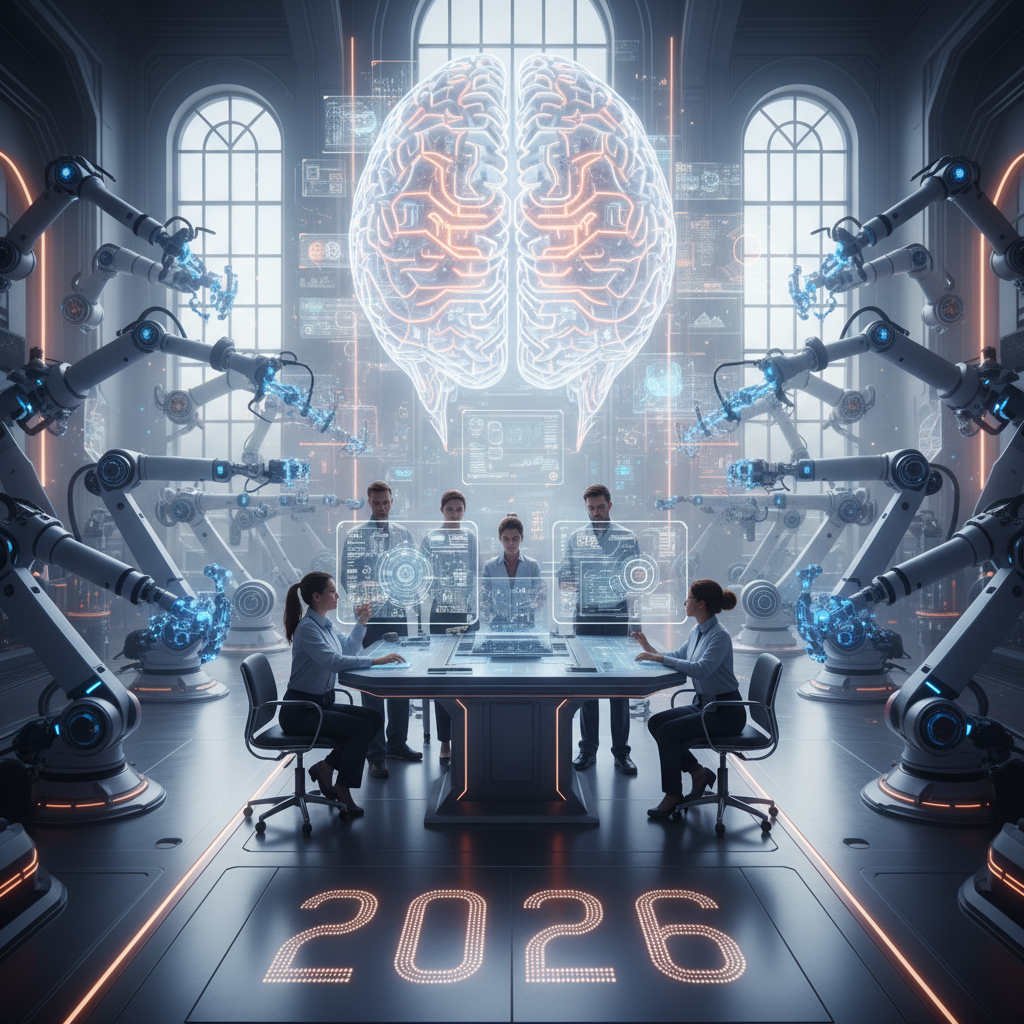
Building a cognitive factory means bringing data and people together to increase quality and productivity. The key point for 2026 is that it's not about "innovating a little," but about changing the way value is created: data quality is like material quality, computing power and skills are like production infrastructure, and collaboration between production, IT, maintenance, quality, supply chain, and sales is key.
In many SMEs, the obstacle is the lack of a bridge between those who understand the process and those who know the digital tools. Hybrid roles, reliable digital providers, and shared platforms are needed, even for those who lack the scale to do everything themselves. A cultural choice is also needed: to stop considering industry a "mature" sector and recognize it as a laboratory for the future, where the digital transition, the energy transition, and new skills intersect.
Industrial Policies, Artificial Intelligence, and the Risk of "Innovation Theater"“
2026 will also be the year in which the country's ability to effectively use the resources available for innovation will be measured. The difference between true innovation and simple spending lies here: a sensor without a process is a knick-knack, software without data is a blank sheet of paper, a model of Artificial intelligence Without people to govern it, it's an illusion. We need incentives that reward real integration, reduced waste, consumption, and lead times, and increased quality and reliability.
As Michael Kremer's "O-Ring" economic theory, also cited in the case of the Space Shuttle Challenger disaster, points out, in some processes the failure of a single step is enough to wipe out the overall value. Applied to Artificial Intelligence, this logic shows that automating certain phases does not eliminate the human role, but shifts the focus to activities where people remain crucial, increasing their impact and requiring new, targeted skills.
Hence the need for "work architects," capable of redesigning roles to ensure complementarity between people and machines. Worker participation becomes essential: AI changes workflows, responsibilities, and hierarchies. Without involvement, the risk is fueling resistance and "innovation theater," consisting of showcase projects with no real impact. With participation and early negotiation, however, modernization becomes a lever for shared growth.
Artificial Intelligence: Impact on Marketing and Business
THE'Artificial intelligence It doesn't just transform production, it revolutionizes marketing, sales, and the customer experience. The same logic of reliable data, real-time decisions, and predictive processes that drive the cognitive factory can be applied to customer relationships: from demand forecasting to personalized offerings, all the way to after-sales support.
In digital marketing, Artificial Intelligence allows for dynamic segmentation, user behavior analysis, and automation of communications across highly effective channels like WhatsApp Business, email, and mobile. This reduces the time between signal and response to a customer, increasing satisfaction and loyalty. Conversational AI tools allow for managing large volumes of inquiries with rapid responses consistent with brand identity.
For manufacturing companies operating in complex supply chains, integrating AI into communications also means improving traceability, order management, and coordination with suppliers and partners. An advanced messaging system, based on automation and official APIs, can connect ERP, CRM, and contact channels, transforming operational data into valuable interactions with the end customer.
Authoritative sources such as the’Wikipedia's encyclopedia on Artificial Intelligence and the reports on Industry 4.0 Ministry of Business and Made in Italy confirm how the combination of AI, automation, and digital channels is now central to the growth strategies of SMEs and large groups.
How SendApp Can Help with Artificial Intelligence and Cognitive Factory
To transform the’Artificial intelligence To leverage real business, platforms capable of connecting internal processes and external communications are needed. This is where SendApp comes in, an ecosystem designed to bring automation and AI directly to the most commonly used customer contact channels, starting with WhatsApp Business.
With SendApp Official – Official WhatsApp API, manufacturing companies can securely and scalably integrate messaging, CRM systems, and data from the cognitive factory. This allows, for example, automatic notifications on production status, shipments, scheduled maintenance, and traceability, leveraging AI logic for message timing and personalization.
SendApp Agent It allows you to manage teams of operators on a single interface, enabling collaboration between technical, customer service, and sales departments. Automation flows can filter out repetitive requests, leaving high-value exceptions to humans, fully aligned with the cognitive factory model. With SendApp Cloud, companies can orchestrate advanced workflows, API integrations, and intelligent chatbots to reduce micro-tasks and communication downtime.
These solutions allow Artificial Intelligence to move from theoretical to measurable results: fewer low-value manual tasks, more focus on relationships and sales, and greater operational continuity even in complex scenarios. For companies looking to make 2026 the year of their breakthrough, SendApp offers a concrete consultancy program on WhatsApp Business, conversational automation, and integration with existing business systems.
To find out how to apply Artificial Intelligence to your communications and business processes, visit the website SendApp and request a demo or free trial of official cloud solutions and APIs. Less ads and more construction: it's time to turn data, conversations, and expertise into a real competitive advantage.