

WhatsApp Business Security: A Practical Guide to Preventing Suspicious Links and Hacking
WhatsApp Business Security It's now a priority for businesses and professionals who use the app to communicate with customers. Security on WhatsApp Business isn't just about privacy, it's also about protecting against suspicious links, scams, and increasingly sophisticated hacker attacks.
In recent years, phishing and account takeover attempts via WhatsApp have increased significantly. Cybercriminals exploit seemingly innocuous messages, often containing malicious links, to steal sensitive data, verification codes, or install malware on users' devices.
For those who use WhatsApp for business, a single click on a bad link can cause the loss of a business account, disruption of customer service, and reputational damage that's difficult to recover from. In this article, we'll look at how to improve your business. security on WhatsApp Business, what threats to monitor, and what best practices to adopt to protect your business.
WhatsApp Business Security: Why Suspicious Links Are So Dangerous
When talking about WhatsApp Business Security, Suspicious links are among the main attack vectors. Hackers create URLs that mimic official websites or login pages to trick people into entering credentials, one-time passwords, or personal information. These links often appear in group chats, broadcasts, or one-on-one conversations.
According to several international cybersecurity reports, phishing via messaging apps is among the most effective techniques for targeting both private users and businesses. A link clicked by a team member can lead to data theft, unauthorized account access, or even device compromise.Source: Wikipedia on phishing).
In a business context, the risk is amplified. A compromised WhatsApp Business account can be used to send fraudulent messages to company customers, request payments, spread malware, or damage the brand's reputation. Therefore, it's essential to implement clear security policies and train staff on the proper use of the app.
Top Security Threats on WhatsApp Business
Phishing and account theft
The most common threat to security on WhatsApp Business It's phishing. Attackers send messages that mimic official communications, such as "Your account will be deactivated, click here to confirm" or "You've won a prize, verify your details.".
In many cases, the link leads to a page that mimics the WhatsApp website or a well-known service. The goal is to steal credentials, verification codes, or convince the user to share the security code received via SMS. Once this information is obtained, hackers can move the account to another device and block the legitimate owner.
Malware and Device Control
Another critical risk for the WhatsApp Business Security It's about malware. By clicking on certain links or downloading attached files, users can unknowingly install malicious software on their smartphone or PC. This malware can record everything you type, access your address book, or monitor conversations.
In the business world, an infected device can expose sensitive information about the company, its customers, and its business strategies. Some cyber espionage campaigns specifically target corporate data through messaging apps widely used at work (Source: ENISA – EU Agency for Cybersecurity).
Social engineering and psychological manipulation
There security on WhatsApp Business It's not just technology: many attacks exploit the human element. Hackers often use social engineering, or psychological manipulation techniques, to convince people to perform risky actions or reveal confidential information.
Typical examples include messages that feign urgency, authority, or emergency: "I'm your manager, send me the code you received right away," or "We have a tax audit, click here to confirm your company details." Without proper training, many employees can fall into these traps.
WhatsApp Business Security Best Practices for Businesses and Professionals
Enable all available security features
The first step to improve the WhatsApp Business Security is to take advantage of the app's built-in security settings. It's essential to enable two-step verification, which adds a security PIN required when setting up your account on a new device.
It's also a good idea to regularly check the devices connected to WhatsApp Web and delete any sessions you don't recognize. Enabling your phone's screen lock with a PIN, fingerprint, or facial recognition further reduces the risk of unauthorized access.
Educate the team to recognize suspicious links
To ensure a solid security on WhatsApp Business It's essential to train everyone who uses the account or handles customer conversations. Basic guidelines include: don't click on links from unknown numbers, always verify the site's domain, and be wary of messages requesting sensitive information or one-time passwords.
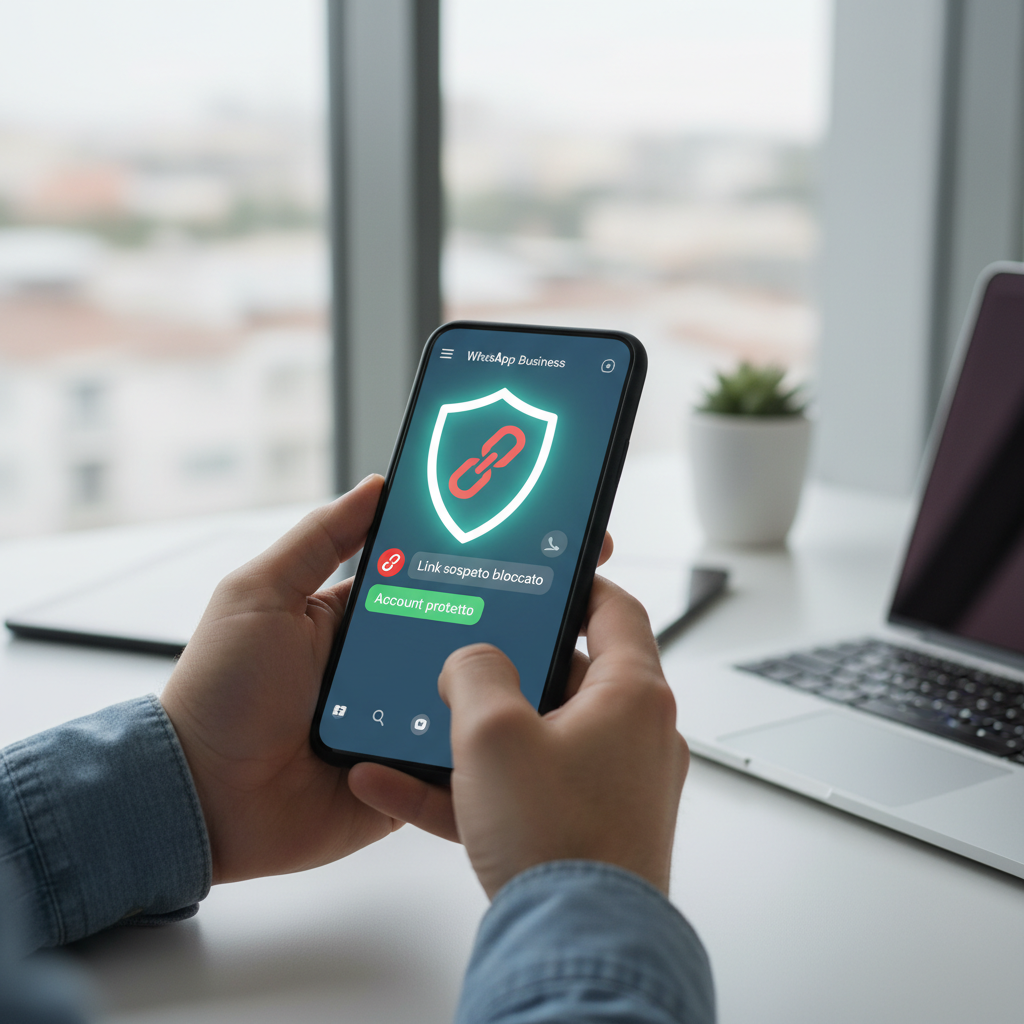
It's helpful to establish an internal policy explaining how suspicious messages, unsolicited links, and payment requests should be handled. A clear procedure reduces human error and makes the company more resilient to attacks.
Use official channels and certified solutions
Another pillar of the WhatsApp Business Security It's the use of official channels and certified partners. Using Meta-approved solutions ensures that communication occurs through controlled infrastructures that comply with internationally recognized security standards.
For companies that manage large volumes of chats or automate parts of conversations, relying on an official platform reduces the risk of technical vulnerabilities, integration errors, or policy violations. It also simplifies the implementation of access controls, activity logs, and secure backups.
WhatsApp Business Security: Impact on Marketing and Business
There WhatsApp Business Security It's not just an IT issue, but has a direct impact on marketing, sales, and customer experience. A secure communication channel increases customer trust and makes every conversational marketing initiative more effective.
If customers receive fraudulent messages supposedly sent by the brand, their perception of trustworthiness plummets. On the other hand, professional security management allows you to use WhatsApp for campaigns, promotions, and customer support in a structured and controlled manner, without putting user data at risk.
From a business perspective, a security incident can result in lost leads, blocked support activities, and damage to your reputation. Integrating the security on WhatsApp Business In digital strategy, this means preventing these situations, protecting brand value, and ensuring business continuity.
A mature approach includes clear guidelines on who can use the account, what messages can be sent, how to handle sensitive requests, and which automation tools to use. This way, WhatsApp becomes a strategic marketing asset, not a security weakness.
How SendApp Can Help with WhatsApp Business Security
For companies that want to improve their WhatsApp Business Security Without giving up the power of the channel, the use of professional platforms is crucial. SendApp offers specific solutions for managing communications on WhatsApp Business in a secure and scalable way.
With SendApp Official (official WhatsApp API) Companies can integrate WhatsApp into their CRM, ERP, or e-commerce platforms using Meta's official APIs. This reduces the risk of improvised solutions, ensures greater access control, and allows for centralized security settings.
For the operational management of conversations, SendApp Agent allows you to distribute chats among multiple operators while maintaining traceability, permissions, and activity logs. This way, the security on WhatsApp Business It is strengthened by an orderly management of roles and responsibilities, reducing the risk of abuse or human error.
Finally, with SendApp Cloud It's possible to automate part of your conversational flows while maintaining high standards of security, backup, and service continuity. Automation allows you to respond quickly to customers without exposing sensitive data, thanks to precise rules on what is shared and how data is managed.
The adoption of a structured platform like SendApp allows you to transform the WhatsApp Business Security From problem to competitive advantage. Companies can thus focus on marketing, sales and customer care, knowing that the channel is managed professionally and in line with cybersecurity best practices (Source: AGID Guidelines on Cyber Security).
To implement a comprehensive security strategy and marketing on WhatsApp For businesses, it's advisable to request a dedicated consultation and test the solutions in a controlled environment. SendApp supports companies at every stage: from needs analysis to official API configuration, from team training to campaign optimization.
If you want to improve the security on WhatsApp Business and maximize the channel's potential for your business, consider a trial of SendApp solutions and immediately build clear policies, reliable tools, and secure processes.