

Artificial Intelligence in Retail: What We Saw at Euroshop 2026
L'artificial intelligence in retail It's becoming the backbone of store and chain productivity. Artificial intelligence in retail is no longer just an experiment, but a concrete lever for reducing costs, optimizing processes, and improving the customer experience.
Euroshop 2026 confirmed a clear direction: technology is the industry's competitive engine. As Marco Zanardi, president of Retail Institute Italy, pointed out, innovation runs on two parallel tracks: back-end optimization and front-end revolution, with a new balance between automation and human capital.
Artificial Intelligence in Retail: Back-End, Demand Planning, and Logistics
According to Zanardi, the application of the’artificial intelligence in retail The focus on the "basic" part of processes will generate greater productivity in the short to medium term, that is, over the next 3-5 years. The focus shifts to the back-end, where logistical complexity requires increasingly advanced predictive and analytical tools.
In this context, demand forecasting and demand planning come into play, two pillars of demand planning. They concern not only retailers, but also manufacturers like Ferrero and Barilla, who are extremely careful about managing sales by individual channel. AI allows them to anticipate needs, reduce stockouts, and optimize inventory, with a direct impact on margins and customer service.
Applying these technologies to logistics, however, is complex. It involves integrating large amounts of data, heterogeneous systems, and external variables such as seasonality, promotions, and macroeconomic trends. As also highlighted by studies on modern retail, the ability to orchestrate supply chains and points of sale is today a critical success factor, especially in multi-channel chains.
From the attention economy to the intention economy: the new front-end
If in the back-end AI optimizes flows and processes, in the front-end the challenge is above all psychological and relational. Here the’artificial intelligence in retail redesigns the direct relationship between brand and customer, introducing the transition from the Attention Economy to the Intention Economy.
As Zanardi explains, with "agentic" AI, we're moving from a typical social media model, based solely on capturing attention, to a logic centered on genuine purchasing intentions. Systems, such as advanced customer engagement platforms (such as those developed by global players like Salesforce), are entering a continuous cycle of personalized recommendations.
They don't just display eye-catching content, but also seek to capture specific needs, preferences, context, and the moment in the customer journey. The goal is to guide the user toward the most relevant choice, with targeted recommendations, tailored offers, and seamless purchasing paths between online and offline.
This evolution, however, requires balance. Customers don't want a completely dehumanized experience: they seek simplicity, speed, and personalization, but also empathy, the ability to interact with real people, and room for autonomous choice. Experience design must therefore combine algorithms and human interaction.
Robotics, Physical AI, and exoskeletons to support human capital
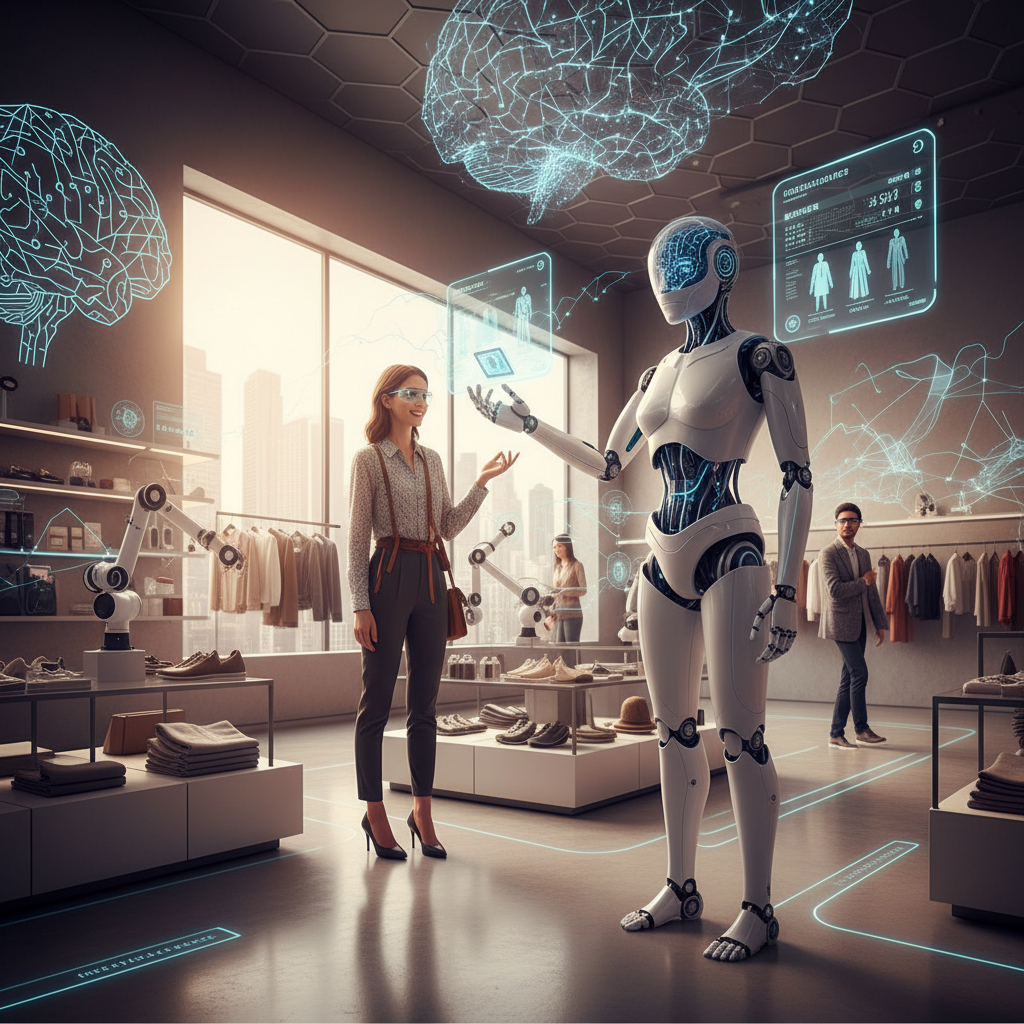
Another pillar that emerged in Düsseldorf is the Physical AI, that is, the application of artificial intelligence and robotics to the physical world. The priority here is not to replace humans, but to empower them, protect them, and lighten the most burdensome tasks.
In warehouses and distribution centers, we see robotics applied to warehousing, with autonomous systems for handling, picking, and storage. Alongside robots, exoskeletons are also gaining popularity: wearable structures that help people lift weights and work for hours, reducing fatigue and the risk of injury.
These solutions, which fully fit into the paradigm of the’Industry 4.0, reveal an inclusive vision of technology. The goal is not to eliminate human capital, but to preserve it, freeing it from repetitive or strenuous tasks and shifting it to higher-value activities, such as customer relations, visual merchandising, and data management.
Retail media, data monetization, and smart shopping carts
When talking about artificial intelligence in retail, It's impossible to ignore the boom in retail media. It's one of the most hyped topics of the moment, as it promises to transform retailers into true publishers, capable of monetizing audiences and proprietary data.
The numbers reported by Zanardi are telling: retail media is worth approximately €620 million in Italy and reaches €25 billion in Europe. AI is a key building block of this ecosystem, enabling advanced profiling, dynamic segmentation, creative optimization, and more precise campaign attribution.
It's important not to get confused, however: machine learning and deep learning are at work extensively in retail media, often invisible to the end user, long before generative AI. The real challenge is effectively monetizing data, turning insights into advertising formats that are useful for brands and non-invasive for consumers.
A concrete example is the solution presented by Toshiba: a smart cart that recognizes handwriting on a shopping list, imports it onto the on-board tablet, guides the customer through the aisles, and suggests related products such as wine or dessert. The application of AI to everyday life is enriched with gamification elements, even going as far as estimating checkout line times.
Retail media isn't limited to screens: ESLs (electronic shelf labels) are creating true in-store communication ecosystems, with dynamic content, real-time pricing, and personalized communications for customer clusters.
Standalone stores between fast and slow retail
Another experimental front concerns autonomous stores, independent shops without traditional cash registers, where the’artificial intelligence in retail It manages product recognition, payments, and security. Here, however, technological enthusiasm must confront the sociological dimension of consumption.
As Zanardi points out, the standalone store responds to a "fast" world. It works very well in metropolises, where time is scarce and quick shopping is the priority, perhaps during a lunch break or between commitments. Outside of major centers, however, grocery shopping is often experienced as a "slow retail" experience.
In these contexts, customers seek connection, time to explore, advice from staff, and sensory experiences. Technology shouldn't make the experience colder, but rather help navigate an increasing complexity of offers, promotions, formats, and touchpoints. As the evolution of the global retail, the key lies in the harmonious integration between digital and physical.
Today's mass consumer market offers a constant intersection of channels: at trade shows, it's often joked that "there's something to eat around every corner." This is precisely why technology must become a strategic design tool, capable of orchestrating processes, simplifying choices, and enhancing brand identity.
Artificial Intelligence in Retail: Impact on Marketing and Business
THE'artificial intelligence in retail It has a direct impact on marketing, sales, and customer experience. On the back end, it enables more accurate planning of assortments, promotions, and inventory, reducing out-of-stock and overstock and improving profitability per square meter.
On the front end, it enables more sophisticated marketing strategies: granular segmentation, offer personalization, cross-channel campaign automation, and predictive analytics on purchasing behavior. This allows you to move from mass communication to a scalable, 1:1 relationship, with content and messages based on intent, not just impressions.
For businesses, AI is becoming the foundation for new forms of data monetization, such as retail media, and for innovative service models, from autonomous stores to in-store digital assistance services. The winning balance is one that combines operational efficiency and perceived customer value, without falling into excessive automation.
In terms of customer experience, integrating AI systems with direct communication channels like WhatsApp allows you to bring the logic of the Intention Economy into everyday conversations: personalized suggestions, helpful reminders, real-time after-sales assistance, order and delivery notifications, in a seamless and natural flow for the user.
How SendApp Can Help with Artificial Intelligence in Retail
To make the operational’artificial intelligence in retail In communications, brands need platforms capable of orchestrating messages, automations, and teams. SendApp It was created to bring the power of WhatsApp Business to the heart of retail strategies, connecting points of sale, e-commerce, and customer care.
With SendApp Official Companies can access the official WhatsApp APIs and integrate AI workflows with chatbots, CRMs, and marketing automation systems. This allows them to send transactional notifications, segmented promotional campaigns, personalized reminders, and order and delivery updates, always in compliance with Meta policies.
SendApp Agent It allows you to centrally manage team conversations on WhatsApp, assigning tickets, monitoring performance, and ensuring continuity between human operators and AI automations. It's ideal for retailers looking to offer pre-sales consulting, in-store assistance via QR code, and post-sales support.
For advanced scenarios, SendApp Cloud It allows you to build complex automated workflows that can be integrated with demand planning systems, e-commerce, and loyalty platforms. This way, companies can bring the logic of the Intention Economy to the WhatsApp channel: messages based on intent, purchase history, preferences, events, and behavioral data.
Retailers who want to take full advantage of the’artificial intelligence in retail They can request a dedicated consultation and quickly start an operational trial of SendApp solutions, transforming WhatsApp into a strategic channel for sales, marketing, and customer care.











This article sheds light on some fascinating developments in retail. The intersection of AI and robotics really does seem to be reshaping customer interactions. I'm curious about how small retailers can adopt these technologies without a huge budget.
The article offers interesting insights into how artificial intelligence is transforming retail. I was particularly struck by the concept of the "intention economy," which could truly revolutionize the way we interact with customers. It will be interesting to see how companies implement these technologies in the coming years.
This article offers some interesting insights into how AI is reshaping the retail landscape. I've seen firsthand how integrating chatbots can enhance customer service, but I'm curious about the long-term impact of robotic assistance on jobs in the sector. It's a fascinating topic with a lot of potential for growth.
This article provides a fascinating look at how AI is reshaping retail. I found the concept of intention economy particularly intriguing, especially how it can enhance customer experiences. I'm curious about practical examples of stores successfully implementing these technologies.