

WhatsApp has become the #1 channel (even if you didn't decide it)
In many Italian companies, WhatsApp has gone from a "convenient channel" to a central channel without a real strategy. It didn't happen with a structured plan, but through accumulation: a customer asks, "Can I message you on WhatsApp?", a sales representative agrees, then support does the same, then administration sends a reminder. Within a few months, a critical part of the customer relationship lives in chats scattered across personal phones, unofficial numbers, and untraced conversations.
The key point is this: WhatsApp is not the problem. The risk arises when WhatsApp becomes business-critical but remains managed as an "informal" channel, without rules, roles, automation, or data control.
In this article we look at the main risks of unstructured use of WhatsApp Business and how to transform it into an asset with marketing automation, Conversational AI and professional tools such as SendApp.
When use arises "for convenience": the risk of random growth
The pattern is almost always the same:
- a customer writes on WhatsApp to speed up a request;
- the operator answers from his own telephone or from an unofficial number;
- chat becomes a preferred channel;
- other people in the company start using it “so as not to lose the customer”;
- Meanwhile, there are no SLAs, shifts, templates, tags, reports, or an integrated CRM.
The result? Communication that works as long as volumes are low and people "remember everything." But as soon as requests, locations, teams, or marketing campaigns increase, inefficiencies and real risks emerge.
Daily signs that indicate a lack of structure
The problem rarely erupts with a single event. More often, it manifests itself through repeated micro-incidents that, when added together, worsen the customer experience and increase operating costs.
1) Duplicate or inconsistent answers
A typical example: a customer writes for a quote. The sales rep responds, "Delivery within 48 hours," while support, ignoring the context, says, "We ship in 5 days." The customer perceives disorganization and loses trust.
2) Messages seen and not handled
WhatsApp is instant: if a message is viewed and goes unanswered, the customer experiences it as a rejection. This often happens on weekends or after hours, when the chat is on a personal phone and there's no response flow.
3) Conversations blocked on a single employee
An important chat remains on the phone of someone who's on vacation, sick, or has changed roles. No one can retrieve the history, no one can consistently take over. This creates dependency on the people, not the process.
4) Information lost in the “noise” of the chat
A customer sends their tax code, address, preferences, photos, and documents. Then the conversation ebbs and flows, and the information gets lost. Without tags, notes, structured fields, and integrations, retrieving details becomes manual and error-prone.
The most dangerous misunderstanding: considering WhatsApp a "secondary" channel“
Many companies treat WhatsApp as an ancillary channel, "on the side." But for Italian customers, it's often:
- the first point of contact (faster than the form);
- the trusted channel (more personal than email);
- the place where decisions are made (quote, confirmation, payment, assistance).
When WhatsApp becomes the place where trust is built (or lost), it can't remain a handcrafted process. It requires professional management: official numbers, assignment rules, automation, tracking, and reporting.
The hidden costs of unstructured use
If communication isn't centralized and measurable, you can't improve it. And if you can't improve it, you can't scale it. Here are the most common costs:
Wasted operating time
Searching messages, copying and pasting replies, internal forwarding, and manual follow-ups. In medium-volume companies, even an extra 1-2 minutes per chat adds up to hours per week.
Lost business opportunities
Leads that go cold because they don't get a timely response, quotes that aren't followed up, customers who ask for information and then disappear. WhatsApp is fast: whoever responds first often wins.
Inconsistent customer experience
Without approved templates, knowledge bases, and automation, each agent writes their own way. The brand appears different from person to person. This reduces the perception of trustworthiness and increases complaints.
Dependence on people
If the channel is tied to a personal phone, the information assets don't belong to the company. This poses an organizational risk that impacts continuity, training, and handover.
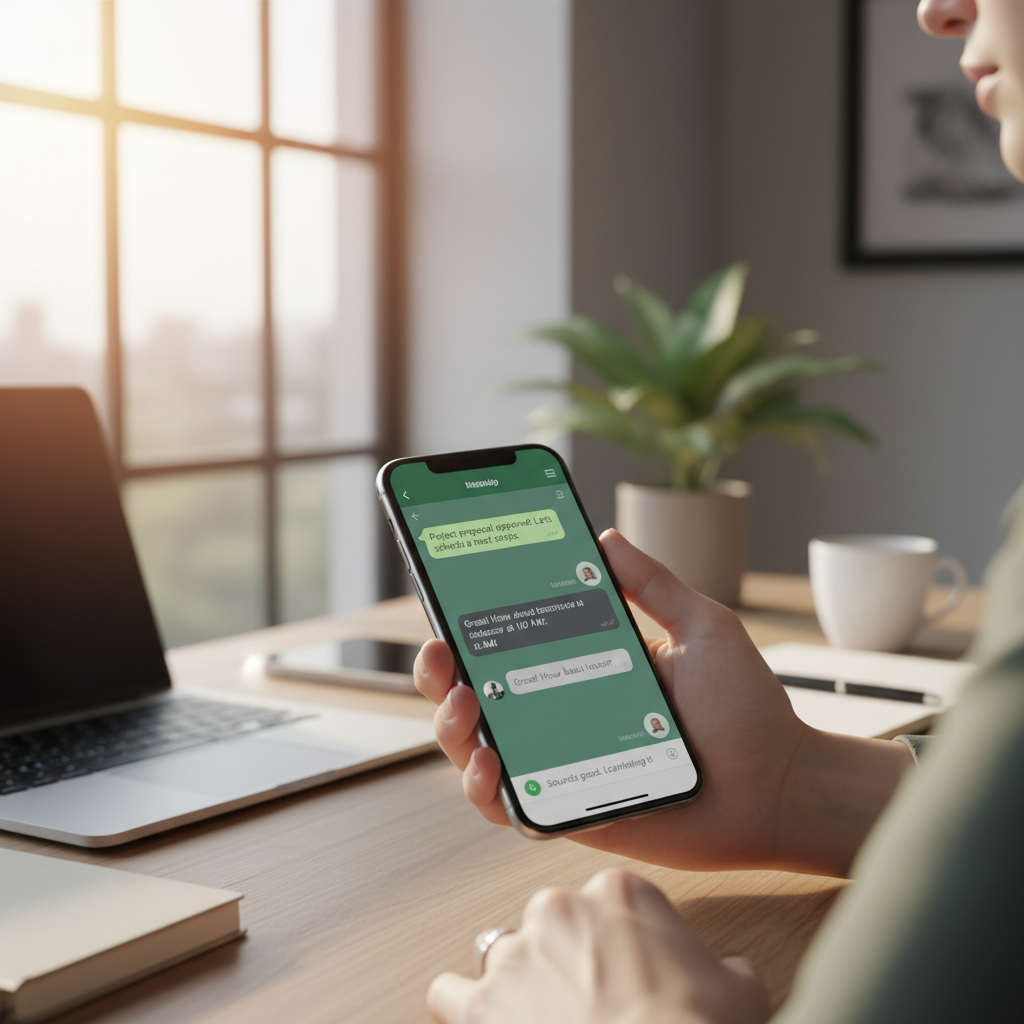
Privacy and Compliance Risks: Why WhatsApp Requires Governance
Beyond efficiency, there's an often overlooked issue: data management. Personal data (addresses, order numbers, health information in some sectors, documents) easily transits through WhatsApp. Without proper configuration and clear processes, the risks of:
- unauthorized access (shared phones, personal backups, clear text notifications);
- lack of traceability (who responded, when, with what content);
- haphazard storage (chats archived without any criteria);
- unstructured consent and preference management (opt-in/opt-out, lists, segmentation).
This isn't a "technical" issue for insiders: it's channel governance. When WhatsApp becomes an official touchpoint, it must be managed as such.
From Chaos to Process: How to Structure WhatsApp Business for Scalability
Transformation doesn't require upheaval, but a clear roadmap. Here are the practical pillars.
1) Centralize conversations on a business number
The first step is to move communication from personal numbers to an official channel, accessible to the team with permissions and roles. This enables operational continuity, handover, and control.
2) Define roles, shifts and response times
Determine who is responsible for what (sales, support, administration) and with what SLAs. Even a simple rule ("within 60 minutes during office hours") can dramatically improve the perception of service.
3) Use templates and quick replies (without losing the human tone)
Templates and quick replies don't mean cold messages. They mean consistency, speed, and fewer errors. For example, a gym can have quick replies for "hours," "memberships," "free trial," and "suspension," while maintaining a friendly and personalized tone.
4) Integrate WhatsApp with CRM and marketing tools
If chats remain isolated, you can't segment, perform intelligent follow-ups, or measure conversions. Connecting WhatsApp to customer data allows for useful and non-invasive automation.
Marketing Automation on WhatsApp: Practical Examples for Italian Companies
When WhatsApp is structured, it becomes a powerful channel for automation and growth, not just for "replying to messages." Here are some concrete use cases.
Retail and local shops: cart recovery and reordering
A cosmetics store in Milan can send an automatic reminder to those who have inquired about product availability: "It's back in stock, do you want us to put it aside for you?" Or activate a reorder flow after 30 days for recurring products.
Catering: automatic reservations and confirmations
A restaurant in Bologna can automate reservation confirmation, reminders three hours in advance, and review requests the following day. The result: fewer no-shows and more reviews, without clogging up the phone.
Professional studies: pre-qualification and document collection
An accountancy firm can guide the client through a process: "Select service," "Upload document," "Choose time slot." The operator intervenes only when truly needed, with everything already sorted.
E-commerce: after-sales assistance and tracking
Automatically send shipping updates, quickly manage exchanges/returns, and dynamic FAQs. Customers don't have to open tickets: they write on WhatsApp and receive immediate, consistent responses.
Conversational AI: When Chatbots Really Improve the Experience
The most common fear is: "A chatbot will make customers angry." This happens when AI is designed to frustrate users. But if designed well, conversational AI on WhatsApp:
- answers repetitive questions 24/7;
- reduces waiting times;
- collects information before handing over to an operator;
- maintains context and history for more accurate answers.
Example: assistance for a medical center
The chatbot can handle frequent requests like "time," "how to get there," "necessary documents," and "test preparation," and then pass them on to the operator only for specific cases. This way, staff aren't overwhelmed by repetitive questions and patients get immediate answers.
Example: Lead generation for a real estate agency
An AI workflow can ask for area, budget, square footage, and timing, and then assign the lead to the right agent with a summary. The client perceives speed and attention, and the agency increases conversion and contact quality.
Operational Checklist: Are you taking risks with WhatsApp?
If you recognize even just 2-3 points, it's time to structure:
- customer chats are on personal phones;
- there is no shared history that can be consulted by the team;
- multiple people respond without coordination;
- you don't measure response times and resolution rates;
- you don't have automatic flows for recurring requests;
- do not segment contacts and conversations for targeted campaigns;
- the transition from WhatsApp to CRM/management is manual.
How SendApp can help you
SendApp offers complete solutions to manage WhatsApp Business professionally and efficiently:
- SendApp Official – Official WhatsApp Business API for bulk sending and automation
- SendApp Agent – AI chatbot with integrated ChatGPT for intelligent automatic responses
- Request a free consultation – Talk to an expert to find the ideal solution